



Word of the Day
Word of the Day

/ǃɔ.te.la/
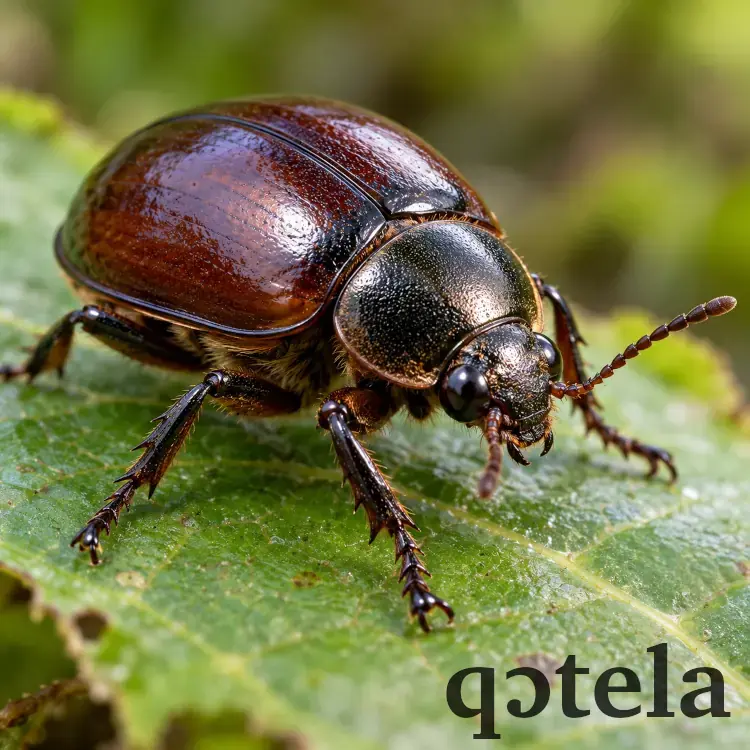
Base function: designate an insect characterized by the presence of a rigid outer covering, often smooth or shiny, resembling a small armor.
qɔtela designates the beetle, an insect belonging to the order Coleoptera, characterized mainly by hardened front wings, called elytra, which generally protect the back wings and part of the body.
Its semantic core is:
hard covering → armor-like appearance → shiny surface → beetle
The name was inspired especially by beetles with a smooth, polished or metallic appearance, whose external surface resembles a small shiny armor.
Nonetheless, qɔtela designates beetles in general, including those that have opaque colors, matte surfaces or low light.
Brightness is part of the original motivation of the word, but does not constitute an obligatory condition for its use.
Uses
Zoo use
Name any beetle, regardless of species, color, size or flight ability.
Descriptive usage
It may appear in contexts that highlight the hardness, shine or protective appearance of the animal's body covering.
Contrast
qɔtas̆e — armadillo; by extension, breastplate. Originally designates a mammal characterized by its rigid body covering.
qɔtela - beetle. Designates an insect whose external appearance has led to comparison with a shiny shell.
cəlah - shine; shine. Designates the perceptible manifestation of luminosity, regardless of the object that presents it.
The similarity between qɔtas̆e and qɔtela it is etymological and perceptual, not zoological.
Limits and usage note
qɔtela does not generically designate any insect with a shiny surface or any animal that has a rigid, armor-like structure.
Its zoological meaning is specific: beetle.
The word also does not imply that the animal is metallic, luminous in nature or capable of producing its own light.
Equivalences in Portuguese
Contextual: coleoptera, beetle (when specifically referring to a beetle from that group).
qɔtela originated from the lexical contraction of qɔtas̆e cəlah, interpreted as “shiny breastplate”.
qɔtas̆e — armadillo; cuirass. Previously formed from qɔta, “hard”, and s̆irewa, “to cover superficially”, with the image of “hardness in coverage”.
The root qɔta It has a phonoiconic origin: the click /ǃ/ evokes a dry impact, /ɔ/ suggests density and /t/ reinforces the sensation of resistance. Already s̆irewa reproduces the gesture of spreading a layer over a surface: s̆i evokes slip, re controlled spread and wa contact and tactile application.
cəlah - shine; shine. Phonoiconic root inspired by the perception of an expanding luminous focus. The element cə evokes a concentrated point of light, while there suggests its noticeable expansion.
During lexical fusion, the components underwent an intense reduction, preserving qɔt- and -and of qɔtas̆e and -there of cəlah:
qɔtas̆e cəlah → qɔtela
Reduction represents a particular lexical contraction, without presupposing a general phonetic rule.
The semantic development was:
shiny armor → small animal with a hard, shiny coat → beetle
The shiny appearance motivated the name, later generalized to all beetles.
- Wa s̆u ys̆ika qɔtela.
I saw one beetle. - Qɔtela cəlah.
THE beetle shines. - Wa s̆u ys̆ika qɔtela ho.
I saw beetles.
Synonyms:
- coleoptera